Company
DeepSeek is a Chinese AI company based in Hangzhou. It is associated with High-Flyer, the Chinese quantitative hedge fund connected to founder Liang Wenfeng.
Updated 2026-07-15 · DeepSeek alternatives move fast
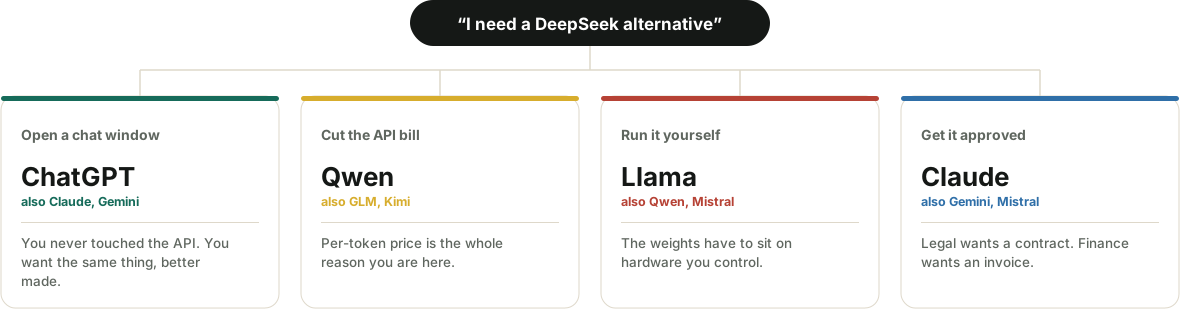
DeepSeek made a lot of people look at their AI bill for the first time. But “alternative” means four different things depending on who is asking: a chatbot to open in a browser, a cheaper API, a model you can run on your own hardware, or a vendor your procurement team will approve. Those are four different shortlists. Most comparison pages mash them into one.
DeepSeek AI explained
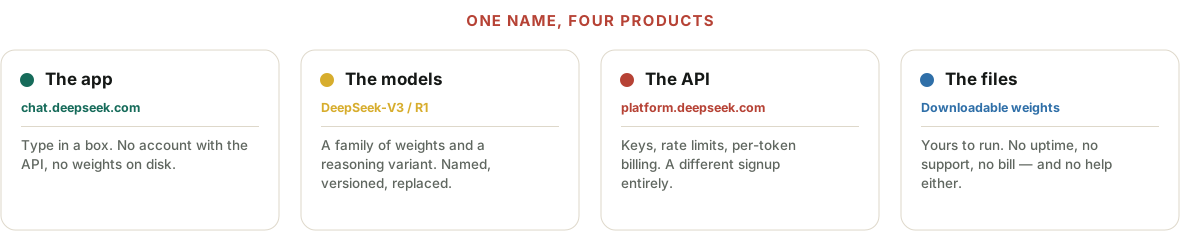
Most confusion here comes from one word covering four things: the app at chat.deepseek.com, the model family, the developer API, and the weights you can download. People switch away from one of them and assume they have replaced all four.
DeepSeek is a Chinese AI company based in Hangzhou. It is associated with High-Flyer, the Chinese quantitative hedge fund connected to founder Liang Wenfeng.
DeepSeek attracted global attention because its R1 reasoning model and V3 model family challenged the idea that only the largest US labs could produce strong frontier-style models.
DeepSeek-V3 is known for a Mixture-of-Experts architecture, efficient training/inference ideas and strong coding/reasoning performance. DeepSeek-R1 made reasoning behavior visible to ordinary users.
DeepSeek models have been discussed as open-weight or open-source-style alternatives because many users and developers can inspect, download or deploy model weights depending on the release.
When an app makes millions of calls, inference cost outweighs brand polish. That is the whole reason developers looked.
DeepSeek is not automatically the best choice for every user. Region availability, filtering, privacy expectations, support, uptime, multimodal features and business approval can matter more than raw benchmark results.
Models and products
The names matter because users often mix up the consumer app, the model family, the reasoning model and the developer API.
| DeepSeek product | Type | What users use it for | What to remember |
|---|---|---|---|
 DeepSeek Chat DeepSeek Chat | Consumer web/mobile assistant | Quick answers, writing, coding help, document-style chat and trying DeepSeek without running models yourself. | Fine for kicking the tyres. Nothing you learn here tells you how the model behaves in your own stack. |
 DeepSeek-V3 DeepSeek-V3 | General model family | Broad chat, coding, reasoning, API use and open-weight model comparison. | The Mixture-of-Experts design is why the training-cost numbers looked so unusual. |
 DeepSeek-R1 DeepSeek-R1 | Reasoning model | Math, logic, planning, coding reasoning and tasks where step-by-step deliberation matters. | Visible reasoning is not correct reasoning. A confident chain of steps can still end somewhere wrong. |
 Distilled R1 models Distilled R1 models | Smaller derivatives | Running reasoning-style models with fewer resources by using smaller Llama/Qwen-style bases fine-tuned from R1 outputs. | Runs on far less hardware. It is also not R1, whatever the model card is called. |
 API access API access | Developer product | Apps, agents, batch jobs, coding assistants and cost-sensitive backend workloads. | Rate limits and caching behaviour decide your real bill more than the headline per-token price. |
Strengths and caveats
R1 is what put DeepSeek on the map, and step-by-step reasoning is still where it earns its keep. Benchmarks travel badly, though — run your own hardest case before you commit.
Cheap enough that developers leave it running in the loop — debugging, explaining unfamiliar code, working through algorithms. Review what it writes anyway.
Bilingual work is where it clearly beats the Western assistants. If your output is Chinese, this is not a close call.
Open weights mean you are not one pricing email away from a rewrite. That is the whole argument, and for some teams it is enough.
At high request volume the price difference stops being a rounding error and starts deciding whether the product ships.
Its real effect was on everyone else’s pricing. Whatever you pick, you are negotiating in a market DeepSeek moved.
Read where the data lands and how long it stays before anything client-related goes in. This is the point most teams skip and later regret.
Filtering is stricter on some topics, and it is shaped by where the service operates. Test the subjects your work actually touches.
A cheap model gets expensive the moment finance wants an invoice and legal wants an SLA. Price the contract, not the tokens.
International access has changed before, at short notice, for reasons that had nothing to do with the model. Have a second option configured.
A benchmark table tells you how a model did on someone else’s work. Use your own repository and your own documents.
Open weights are not an open training set, and they are not a contract. Three different things, often sold as one.
Comparison
These fifteen do not compete with each other. A downloadable model and a consumer chat app answer different questions, and comparing them on one axis produces a ranking nobody can act on.
| Tool | Brand | What it is actually for | Where it bites |
|---|---|---|---|
 QwenChinese model family · China QwenChinese model family · China | Alibaba | The closest like-for-like swap. Same open-weight posture, same bilingual strength, a wider model line-up. | The naming is a maze. The chat app, the API models and the downloadable weights are three different products with three different limits. |
 KimiChinese chatbot and model family · China KimiChinese chatbot and model family · China | Moonshot AI | Built its name on very long documents. Give it the contract, the paper, the whole codebase dump. | Outside China the consumer app and the API are not the same product, and phone verification stops most international sign-ups. |
 GLM / Z.aiChinese open model family · China GLM / Z.aiChinese open model family · China | Z.ai / Zhipu | What developers reach for when they want open weights and agent tooling from the same vendor. | Free tiers throttle under load. Test a burst of calls, not one prompt. |
 ERNIEChinese big-tech AI · China ERNIEChinese big-tech AI · China | Baidu | Only makes sense if you are already inside Baidu — search, cloud, or a product aimed at China. | Outside that ecosystem it is the wrong tool. English docs are thin and the assistant assumes Chinese context. |
 HunyuanChinese big-tech model · China HunyuanChinese big-tech model · China | Tencent | An enterprise cloud decision. You choose it because your infrastructure already runs on Tencent Cloud. | There is no consumer story here worth putting next to DeepSeek Chat. |
 DoubaoChinese consumer chatbot · China DoubaoChinese consumer chatbot · China | ByteDance | The most polished consumer app of the Chinese group — the closest thing to the ChatGPT experience. | This is a consumer product, not an API decision. If you came for cheap tokens, look elsewhere. |
 MiniMaxChinese model company · China MiniMaxChinese model company · China | MiniMax | Strongest of the group on multimodal and voice. | Thinnest ecosystem of the nine. Fewer integrations, sparser docs, more that you assemble yourself. |
 BaichuanChinese model company · China BaichuanChinese model company · China | Baichuan AI | Belongs on a market map rather than a shortlist. | If you are not tracking the Chinese LLM market as a market, skip it. |
 iFlytek SparkChinese AI assistant · China iFlytek SparkChinese AI assistant · China | iFlytek | Speech first. iFlytek has built Chinese speech recognition and synthesis for two decades. | Judge it on audio. Compared purely as a chatbot it looks unremarkable. |
 ChatGPTWestern general assistant · United States ChatGPTWestern general assistant · United States | OpenAI | The default move for anyone who used DeepSeek Chat as a chatbot and never touched the API. | You are paying for the product, not the tokens. On raw API cost this is a step backwards. |
 ClaudeWestern writing and reasoning assistant · United States ClaudeWestern writing and reasoning assistant · United States | Anthropic | If DeepSeek was doing your writing, this is the upgrade. Long documents, editing, review. | Usage limits bite heavy users sooner than the headline price suggests. |
 GeminiGoogle ecosystem assistant · United States GeminiGoogle ecosystem assistant · United States | Worth it for the Workspace wiring rather than the model. Gmail, Docs, Drive, Android. | If your DeepSeek usage was API calls from a backend, the integration buys you nothing. | |
 MistralEuropean model company · France MistralEuropean model company · France | Mistral AI | The European option when data residency is a procurement requirement rather than a preference. | “European” is not a capability. Choose the specific model, then check where it runs. |
 LlamaOpen model ecosystem · United States LlamaOpen model ecosystem · United States | Meta | Not a product — a set of weights. You run it, on your hardware, under your rules. | Self-hosting moves the cost from an invoice to your ops team. Budget the GPUs and the person who maintains them. |
 MultipleChat AIPremium all-in-one AI workspace · International MultipleChat AIPremium all-in-one AI workspace · International | MultipleChat | One subscription, several models, side by side, with files and shared threads. | Disclosure: we operate MultipleChat AI. It is paid, and it is not a free DeepSeek replacement. |
Buyer logic
Qwen, Kimi and GLM are the three that matter. The other six are a market map, not a shortlist — useful if you are tracking the sector, noise if you are picking a tool this week.
Decide which kind of free you mean. A free chat window, a free API tier and downloadable weights are three unrelated things, and only the last one survives a vendor changing its mind.
A paid workspace earns its keep only if you genuinely switch between models during the day. If you open one chat window and stay there, you are paying for a feature you will not use.
Task map
Sources
Prices and limits on this page go stale fast. These are the primary sources — check them before you pay or deploy.
Connected sites
FAQ
DeepSeek is a Chinese AI company known for low-cost language models, especially DeepSeek-R1 for reasoning and DeepSeek-V3 for broad chat, coding and API use.
For Chinese AI, test Qwen, Kimi and GLM/Z.ai first. For mainstream everyday use, test ChatGPT, Claude and Gemini. For a premium all-in-one workspace, compare MultipleChat AI.
DeepSeek is popular because it combines strong reasoning and coding performance, open-weight model releases and low-cost API economics in a way that challenged assumptions about AI development cost.
DeepSeek-R1 is the reasoning-focused model that made DeepSeek widely known. It is used for math, logic, coding reasoning and multi-step problem solving, but outputs still need verification.
DeepSeek-V3 is a general model family known for efficient Mixture-of-Experts style architecture, strong open-model positioning and broad chat/coding capability.
No. MultipleChat AI should be described as premium and paid, not as a free DeepSeek alternative.
Important names include Qwen from Alibaba, Kimi from Moonshot AI, GLM from Z.ai/Zhipu, ERNIE from Baidu, Hunyuan from Tencent, Doubao from ByteDance, MiniMax, Baichuan and iFlytek Spark.
Compare Qwen, GLM/Z.ai, Kimi, Claude, ChatGPT, Llama and Mistral on your own repository. Do not trust a single benchmark screenshot.
For strict control, compare local/open models such as Llama, Mistral, Qwen or GLM deployments. For business SaaS, check vendor terms, retention, training policy and admin controls.
It depends on the data, vendor, region, contract and deployment. Do not upload sensitive company, legal, health or customer data without approval.
Sometimes for price-sensitive reasoning or coding workflows, but ChatGPT is usually more polished as a broad consumer assistant. Test both with your own tasks.
For writing and long documents, Claude. For cost and for running the weights yourself, DeepSeek. They are not really competing for the same job.
Use a premium workspace when model choice, files, collaboration and convenience save more time than the subscription costs. Use free/open models when cost or control matters more.